Itself Towards The Heights

  • The TBF 50 Mile Mountain Bike Race

    The TBF 50 Mile Mountain Bike Race

    This post was originally published to a now-archived version of this blog.

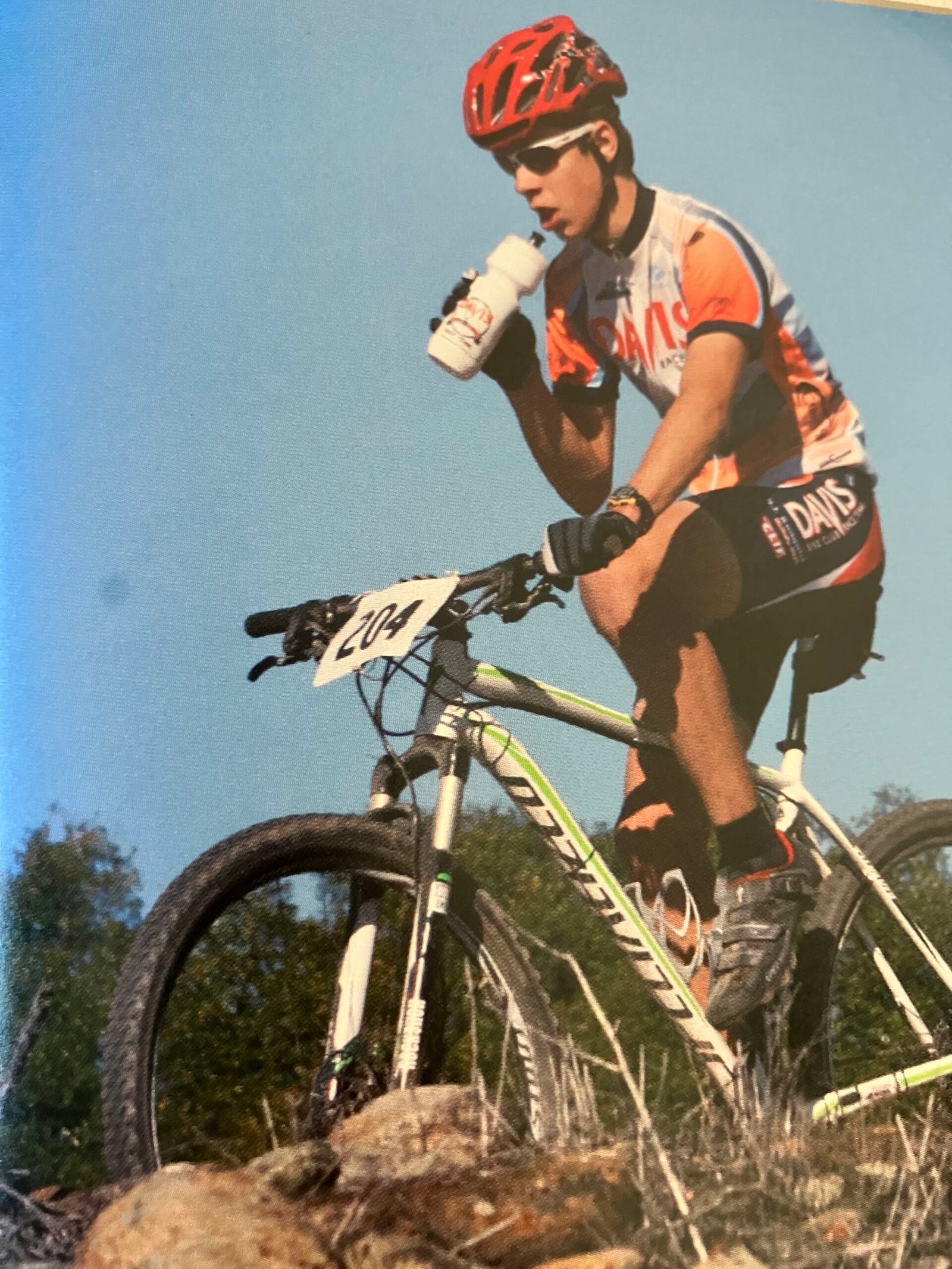
    Yesterday, I was going through some old emails, and came across my race report from my first real introduction to endurance racing: The TBF 50, a 50 mile mountain bike race in Granite Bay that I completed when I was 16. In terms of execution, the race was definitively the worst I’ve ever done. And yet, it was easily one of the best days of my life, and ever since that day I was absolutely obsessed with ultra-endurance sports.

    On October 24th, I’ll be racing the NorCal Backyard Ultra (Mini) — a 12 hour Last Man Standing — which will take place on the exact same trails in Granite Bay. It seems fitting that my debut return to endurance racing and ultrarunning is happening at the same place, on nearly the same day.

    In anticipation of that return, I thought I would post the race report here, unedited, as it first appeared in the email list servs many years ago, typos and all.

    I hope you enjoy J.


    October 20, 2013

             The story of the TBF 50 begins on a cold morning sometime mid June, when I first committed to racing the TBF 50. I had a simple, yet seemingly effective way to train; each month, I would do a race with 10 miles more than the previous month’s, working my way up to 50 Miles. I started with Skyline XC Mountain bike race late July, a 17 mile mountain bike race over some steep and rocky terrain. Next month, I raced the Annadel XC Mountain Bike Race, which was 30 miles, very rocky, and pretty steep as well. Then I lucked out and got to race back-to-back for a few weekends. After Annadel came the M5 Mountain Bike Madness. This was a four day-three night mountain bike event in the Mendocino Woodlands, with excellent food and a Race at the end. This race tested me more than any other race yet. The M5 had 5,200 ft of total climbing, and it took me almost four hours to complete, and for the first time I truly “bonked” and totally ran out of energy on the last lap, ill admit, it was a pretty scary feeling. The week after the M5, I had another race, this time in Caspar, a little town near Mendocino. This race topped off at 33 miles, and a little less climbing about 5,000 ft of climbing. I finished the Caspar under four hours, and felt very confident about my training so far, having conquered so many obstacles, and finishing races I previously wouldn’t have believed I could do.

             I took a two week break from racing, and then had the Folsom Cyclebration Mtb Race. I finished a little slower than I would have hoped, and was extremely exhausted at the end. My next month of training consisted of cyclocross; The Sac CX #1, the Bay Area Super Prestige #1, and then the Sac CX #2. My score slowly improved with each CX race, and I felt better about the coming 50miler.

             Saturday, October 19th, woke up early to take the PSAT, and when finished, headed out to lake Solano to help at a Foxy’s aid-station for the remainder of the day. All day Saturday I had allergy issues and started freaking out about the 50miler, worrying my allergies wouldn’t go away in time. I also got very few hours sleep that night and was pretty tired. Saturday night, I slept a little better though.

             I woke up Sunday morning at 5:30, and my mom and I were backing out of the driveway by 6:00. We stopped for breakfast at star bucks, but I wasn’t feeling too hungry. We arrived at Granite Bay an hour later, unloaded my bike, and got me checked in. I could feel the mixture of pressure and excitement for the race slowly building up, giving me the pre-race butterflies.

             All the solo riders started at 9:00 together. There was an enormous amount of dust in the air, and it limited my visibility to the rider ahead of me. My first lap went great. I zoomed around the course, finishing my first lap in 59 minutes. Halfway into the second lap though, I started to slow down.

             From the very first lap of the race, I had a knot in my back whenever I bent over, and thus, my back was aching the whole ride because of my ride position. At first, I thought it would go away pretty fast, but it became apparent that that wasn’t going to happen. Halfway through the second lap the pain was pretty intense, and by the third lap, it was almost excrutiating. I slowed down considerably as time went on, tiring out quickly. About two thirds into each lap, there is a very steep climb up to a water tower. I barely made it to the top during the second lap. I started to feel pain in my legs. I begun to get tired. When I started the third lap, I was barely hanging on. I felt like I was losing energy, despite the Clif Shots I was taking each lap. My arms begun to get tired of holding me up, and my back was pushing me close to tears. I pedaled on.

             Somehow, I pulled it together for a few minutes, and went slightly faster as I neared the end of the third lap, but another climb towards the end of the lap slowed me down considerably. When I started the fourth lap, I stopped by my mother and uncle as they handed me a fresh water bottle. I unclipped, and got off the bike, and my mom tried to get me to stretch and see if I could get rid of my back pain, or if I could gain back a little energy. I did, but it was short lived. As soon as I was out of sight of the spectators and the finish, I slowed down. After I mile, I stopped again. I managed to get back going, but then stopped again two miles later. I sat for a while, trying to get myself to go, but I didn’t move for five minutes. I begrudgingly started again, but after another mile, I just couldn’t go any further. I sat down in a sandy patch of dirt and lay back for a while, letting the sun beat down on my face. My back pain didn’t go away. I watched rider after rider pass me by, but couldn’t find the strength to go on. I begun to consider giving up.

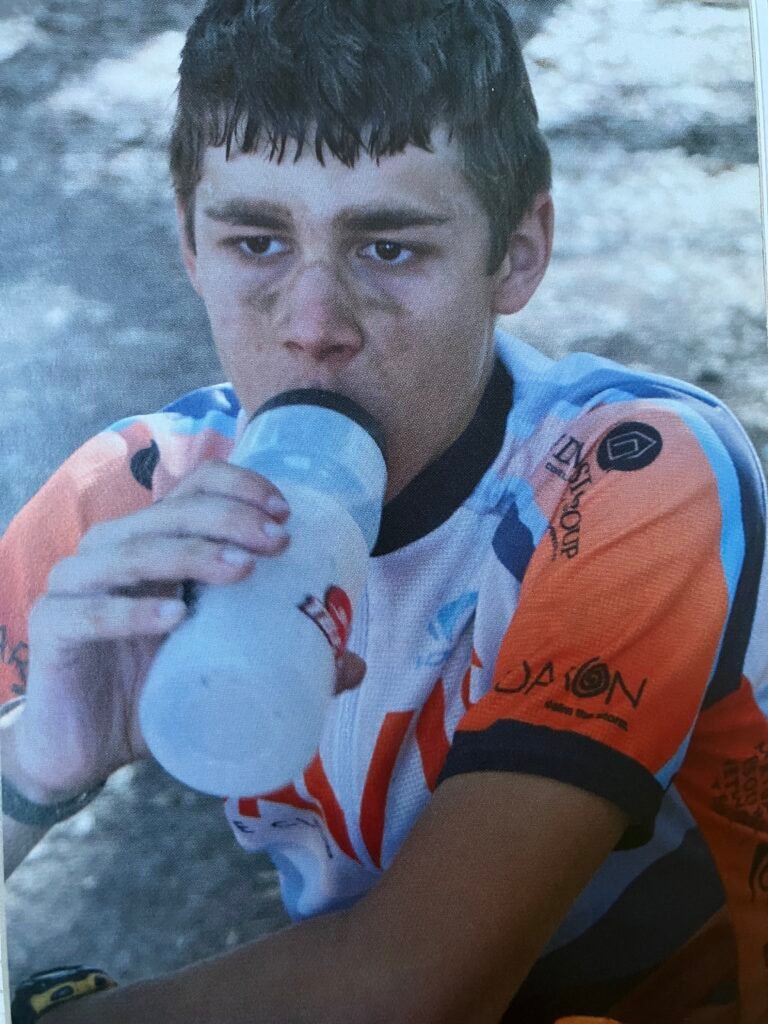
             The thought of giving up truly scared me, because I had been training for this race for a while, and it was so important to me I never dared think I would ever consider giving up. I always finished a race, no matter what it took, and thus was truly scared as I considered that I couldn’t finish. I argued back and forth in my head; Should I go on? Should I give up right now? Should I wait until I see a race official who can drive me back? Then came Trevor. He was another racer, who, like me, was ready to give up. He was pushing his bike around the corner, and when he saw me asked if I was okay. I told him yes, I was just tired. He said he knew how I felt, and sat down too. It turns out, he had only ever ridden 20 miles in his life, and was having just as much, if not more, trouble than I was. We got up eventually, and stuck together the rest of the race, relying on each other to help each other finish. We were both beyond tired. We averaged about 4 miles per hour, stopping ever mile or so sit down and rest up. When we got the big climb towards the second half of the lap, we both thought we would die. Through sheer effort, and my mom running up the hill cheering us on, we made it to the top. When we both were at the summit, I asked “wanna rest a sec, or go on?” to which he replied “lets get this sh*t over with.” Some miracle must have happened if he and I had the energy to swear. In a wave of pain and fatigue, we descended the other side, and pushed our selves too, and past any physical limit. As we made the turnaround, and new that we had less than two miles to go, we picked up speed. As the final section of single track loomed ahead of us, we both got out of the saddle, pedaling like our lives depended on it. Somehow, we both finished, riding 50 miles in 5:09:00. We shook hands past the finish line, and went to go get our post-race meals.

    A 1,000-yard stare during the post-race meal

             The TBF 50Miler was by far the toughest challenge I have ever faced in my life. I pushed myself beyond 100 percent, and yet underwent the realization that I wasn’t prepared for the race that lay ahead of me. I came extremely close to giving up, and likely would have, if somewhere deep down in side of me I didn’t find the strength to go on. I didn’t meet my time goal, didn’t finish very high, and stopped more times than I would have liked, but I did finish, and that matters more to me than anything else. I know I have allot of room to get better, but I also know my strengths, and my limits, and that is a luxury I am glad to have. Thus officially ends my 2013 season of mountain biking, and I can relax J.

  • Thursdays

    Thursdays

    This post was originally published to a now-archived version of this blog.

    I’ve had insomnia my whole life.

    As a child, I was placed on ADHD medicine, which had the unfortunate side effect of keeping me awake throughout a significant portion of the night, so that I regularly was lucky to get a mere 4-5 hours of sleep. As an adult, the insomnia got worse. It peaked in the fall of 2021, my last semester at UC Berkeley before I withdrew. Despite my best efforts to do all of the “correct” sleep hygiene activities—dimming lights, reducing screen time, drinking a cup of chamomile, minimizing daily caffeine intake—I just couldn’t sleep. I began having periods where I wouldn’t sleep for two days, and on the third, would barely get five or six hours. Averaging 4-5 hours per night, and regularly getting no sleep at all, academic success in college became a near impossible challenge. But, I refused not to try. I gave it my best effort: I went to class. I worked as hard as I could on my homework. I exercised—Exercise was often the one thing that could get me some sleep, and so I did so religiously. In the middle of the semester, I had gone on a short run with a friend of mine, when all of the exhaustion finally caught up with me. I collapsed. I couldn’t stand up. I couldn’t keep my eyes open. And yet I couldn’t sleep either. This friend sat with me for half an hour, and then put my arm around his shoulders, and carried me back to his apartment. That felt like an eternity. There, he walked me upstairs, closed the blinds, and let me lie down in his room. He had to leave for a meeting, he said, but I could stay and sleep as long as I liked. And yet, even then I couldn’t. I was in this horrifying intermediate state where my body felt physically wrecked, as if every single cell within was screaming at me to sleep, and yet the neurons of my brain just couldn’t figure out how to do it. It was like a bad dream, where you’re running from something, but you can’t move. But even that would be better, because to dream, you must be asleep. I tossed an turned in his room for a full 24 hours, before somehow gaining enough energy to get up and struggle home. There, I lay in bed for another 24 hours before sleep finally came to me.

    That was nearly four years ago. After that semester, I withdrew from college. I went to EMT school, got a job as an EMT, and discovered the incredibly profound passion I now have for helping others, and emergency medicine. Since then, my sleep has slowly improved. Working in EMS was, I believe, largely responsible for this. I believe that our minds and bodies are capable of much more than we realize, and oftentimes things that feel impossible become easy when the circumstances give you no other option. In EMS, people’s lives are on the line. Sleep just doesn’t become a priority any more. Like most places in EMS, the system I worked in was incredibly understaffed, and it was common to get mandated for day shifts if you were on nights, or vice versa. In EMS, you don’t get to be tired. You don’t get guaranteed sleep. The only thing you can count on is that you have the responsibility of someone else’s worst day on your shoulders, and something about that responsibility changes the game: You learn how to function on less sleep, because there’s no other option. Since then, my sleep has continued to improve. I now routinely get around 7 hours per night. I do light therapy every morning, where I essentially start every day by sitting in front of a painfully bright LED, which physiologically mimics sunlight and helps regulate my circadian rhythm. But sleep is still a tenuous process for me, and the exhausting haze of sleep deprivation is still a regular battle I face.

    Enter Thursdays.

    Thursdays are consistently the most challenging day of my week. In addition to insomnia, I also have to constantly balance my ADHD. I don’t take medication for it, because medications often tend to give me pretty bad side-effects (including worsened insomnia), and so I regulate my ADHD behaviorally. One thing I know about my ADHD is that my focus is the best early in the morning. If you combine this with the fact that I also simply enjoy the quiet peace of the early morning, I tend to wake up somewhere between 4:00AM and 6:00AM most mornings. I go through a quick morning routine, and then sit down at my desk, turn on my light therapy lamp, and begin studying. On Mondays, Tuesdays, and Wednesdays, this process comes easily to me. I wake up energized and excited to get started with my day. Except my Wednesdays are long. I usually don’t get home until 9:00PM or later, and often am not done with work and in bed until midnight—which means Thursday morning is a freaking battle.

    When my alarm goes off on Thursday morning, unlike Monday through Wednesday, I do not immediately get out of bed. I slowly sit up, and stare confused at my alarm for a minute before I realize that it’s making noise, and turn it off. The enemy has drawn first blood. I move slower. I take longer to brush my teeth. I’m clumsy with my coffee, and spend a few minutes wiping up the grounds I spilled over the counter. I trundle back to my desk, and sit down. I turn on my light therapy lamp, open Anki on pure muscle memory, and begin studying. Perhaps, in the overall war, Thursday morning is a mere skirmish that historians won’t even deign to name. But for me, in those early morning moments, it’s a to-the-death onslaught between every hardwired fiber in my body and mind telling me:

    Go back to bed!
    Sleep a little bit more… studying isn’t this important.
    Your goals can wait.
    Study another day.
    Work towards becoming a doctor another day.
    Just go back to sleep!

    And that one little voice of dissent in the back of my brain, shouting at the top of his lungs:

    NO! SCREW THAT!
    You are counting on yourself to reach your goals. Don’t let yourself down.

    I am a firm believer that who we are is defined by our actions when things stop getting easy. It’s easy to say that you want to be a doctor on a Monday when you’ve gotten nine hours of sleep and woke up feeling refreshed and ready to start your day. But what about when it’s Thursday morning and the devil on your shoulder is doing everything in its power to get you to give up and go back to sleep? No single Thursday morning will make or break my whether or not I achieve my hopes and dreams of becoming a doctor. But over time, those Thursdays sure add up. In wildland fire, there is the saying: “Ounces are pounds.” Indeed, Thursdays are ounces, but they add up. How my Thursday goes often defines the rest of my week. If I lose that battle, and sleep in, a snowball effect begins; maybe I skip my workout to catch up on studying, and feel sluggish on Friday. Then Saturday and Sunday are spent getting back on track, and little progress is made. While if I push through that battle on Thursday morning—not if I win, but merely if I don’t give up and go back to sleep—I’ve set the tone for the rest of my week, and progress is made.

    I am far from perfect, and there are many Thursdays where I lose the battle. But more than anything else, I am grateful for the challenge that each Thursday morning provides me, and I look forward to it. I am no longer in the life-or-death world of EMS or wildland fire. As I return to college, trading shifts on the box for shifts in the library, and handoff reports to a code team in the ED for handing off my homework to a TA, my day-to-day life does not consistently have the life-or-death responsibility that is the burden of working in EMS or similar fields. Now, the only life-or-death responsibility I have is to myself: Because indeed, every action I take determines the outcome of my life. Whether or not I wake up early and slog through two hours of Anki, exhausted from lack of sleep, or simply snooze my alarm, may be the difference between realizing the dreams I hold for my life, or watching them all slip away. And in some ways I find this harder; I find responsibility to others easier than to myself. Now the only person my actions affect is myself, and I am not as disciplined as I want to be. But Thursday mornings give me the opportunity to practice that discipline. Consistency is the most powerful weapon one can have, and so that’s what I focus on with my Thursdays. And while the progress is slow, over time that snooze button has gotten a little less love, and waking up each Thursday morning has become a little bit easier.

    The exhaustion of lack of sleep, which once felt like a weakness to me, has become my strength. I now view my insomnia as a strength; a regular chance to practice discipline, and a chance to do the things I want to when it is hard, not just when it is easy.

    I’m writing this on a Friday, the morning after a particularly rough Thursday. Yesterday was a freaking battle, and I’m not sure I came out on top. I slept longer than I wanted to. I didn’t get all of the studying done that I planned on. I had to triage my workout to a different day. But I didn’t give up. I got every single Anki review done, squeezing them in on my phone between other things as I walked from meeting to meeting. I meal prepped. I finished all of the preparatory work I needed to do for my tutoring sessions this weekend.

    I didn’t give up. And now, it’s Friday, which means it’s time to refit, refocus, and prepare again for the next Thursday battle, so I can do it all over again.

  • Happiness, From The Mountains

    Happiness, From The Mountains

    This post was originally published to a now-archived version of this blog.

    I don’t really know what “happy” is.

    My entire life I’ve felt a sense of purpose; at times merely the drive to do something, and to do it with everything I’ve got. At other times, that purpose has been much more clear: When I was studying math at UC Berkeley, it was to become a mathematician. When I left UC Berkeley and became an EMT, it was help people. When I left EMS to be a wildland firefighter over the summer, it was externally to fight fire, and internally to do something that sucked, and become stronger from it. Purpose is a constant presence in my life, but rare are the times I’ve felt happy. Those times are usually more emotional (feeling happy versus being happy). Halfway through the summer fire season, on the Borel fire, we had been spiked out in a steep canyon, and the days had been hard. It had been an active fire with some exciting days, and little sleep. It was hot, the terrain sucked, the digging was awful, and the brush was thick. On that fire, as with many, I had slipped into a state of survival mode, simply focusing on putting one foot in front of the other. I was exhausted, sore, weak, and broken down. On our last day, we hiked straight out of the bowl. Our path took us over a significant amount of slab rock that was pretty high up, and I am deathly afraid of heights. The hike was a fear-inducing challenge on top of what had been two weeks of continuous challenge. I hated every second of it, and because of that, I loved it. When, dry heaving, I crested the top to see our captain waiting for us and the buggies just behind the tree line, I felt a sense of pride and satisfaction deeper than anything I’d ever felt before. Moments like that, though few and far between in my life, are the closest I’ve ever gotten to happiness.

    Most of the time, however, I don’t feel happy. No. Purpose and mission drive me, and when I’m successful, I feel a deep sense of satisfaction. And that’s okay with me. I’ve always been a person with that negative affect. I began seeing a therapist for depression when I was still in elementary school, and at times have felt so depressed as to have let it overshadow my entire life. It’s just who I am. Most of the time it just feels like I’m really tired; that even after 9 hours of deep sleep, I just don’t have the energy a rested person should. And so I’ve always been motivated not by the reward of happiness but by the an absolute abhorrence of failure. You could say that between the carrot and the stick, I’m more of a stick guy. But there are emotions—satisfaction after doing something I wasn’t sure I could, or the pride of overcoming a difficult obstacle, and especially, the pleasure of the discomfort of doing the hard thing itself because I know it’s making me a better person—that are, in their own way, my own personal kind of happiness. And where I’ve felt that, by orders of magnitude more than anywhere else in my life, is alone on the trails, in the mountains.

    I got into endurance sports in junior high school, when I started mountain biking. Ever the child to not be satisfied with “normal” I quickly became interested in a 50 mile mountain bike race, as opposed to the shorter 12ish mile cross country races that happened on occasion in my area. Training for that 50 mile race became everything to me. At the same time, school was awful—I was getting bullied daily, and my grades were very poor—but alone on the trails, there was no one there to call me names, to tell me I was a failure, to corner me and punch me—there was only the trail in front of me, myself, and my thoughts. Already an introvert and recoiling from social contact due to that bullying, the solitude of the trails became a place of safety. Free to set my own standards, I graded myself on my effort, and when I worked hard and got a good training ride in, I could be genuinely proud of myself. And as I stuck with it, the mountain biking became proof that I could be good at something. The mountain bike community was very welcoming of me, and I quickly made friends in a way that I never could at school. The 50 mile race came and went. Mountain biking turned to road biking, and the trails of the lower Sierras were replaced with the winding roads of the upper Sierras. When I got a little older, the roads of the upper Sierras became replaced again with trails, culminating in my completion of a 50km run, in 7 hours and 15 minutes. It’s no wonder then why I felt called to wildland firefighting.

    Trail running, since I first fell in love with it, has become an act of spiritual reverence. When training for an event, I would routinely spend my entire day alone, on various legs of the nearby mountains. With nothing to do but think for hours, I would work through all of my thoughts and feelings, all while putting one foot in front of the other. It would get hard, and I would get to measure myself against my own force of will. Some days I would run eagerly into the Pain Cave and emerge from it standing tall, head held high. Other days I would crumple over and find myself sitting on the side of the trail, head buried in my hands. What I’ve always loved about (ultra) trail running is that it’s allegorical for life: Alone on the trails, nobody else can do the work for you. If you’re having a bad day, and you’re still 10 miles out from the trailhead, nobody can come carry you to your car. You can either sit down and give up, or find a way to keep moving forward. It’s not about how fast you can go, but instead, about your ability to continue moving forward, no matter what happens. The successful ultra runner is the one who never gives up. Over the course of a 5 hour run, there are incredible highs, horrible lows, and everything in between; Fighting up and fighting down the trail, over mountain after mountain, trail running gives you complete ownership over everything immediate to your life. It shows you what you’re made of.

    Thus, running appears at every important moment of my life. For the last three years, I’ve been struggling with chronic pain in my right hip, and after many doctor appointments, and many confused doctors, we finally came to a diagnosis of psoas impingement. Since then I’ve been working with a physical therapist, and making improvement, but it’s been slow progress. As a result of this pain, I’ve been limited in what exercise I can do, and have felt distance grow between myself and my roots as an endurance athlete. I’m following the mantra of “do what you can.” These days my runs are 5 miles long, and my lower body workouts are limited to 2 sets x 8 reps of trap bar squats (just the bar). But I still get out into the mountains whenever I can.

    Last month, I went for an 8 mile run hike: When my hip felt good, and when on flat or moderately downhill grades, I would jog. The rest, I would hike. While I ran and hiked, I listened to Episode 415 with Arthur C. Brooks of the Jocko Podcast. Brooks is an author, professor, but most importantly, a happiness researcher. On the podcast, he argues that young men need four things to be happy: Hard work, ambition, “a sense of the divine,” and a partner who will stand by them and yet hold them accountable when they fall off of their path. It seemed as if Brooks took everything I had understood about my own life but had not been able to articulate, and explained it succinctly to me. Hard work and partnership are as concepts self-explanatory. Ambition is the act of having a specific goal (a purpose) to work towards that is challenging enough to legitimately warrant that hard work. A sense of the divine is a spiritual foundation to that ambition; that your goal is something bigger than yourself. It is the why to the hard work. I thought about these things as I listened. I can work hard. I’ve always had ambition in the sense that I’m never satisfied with simply being ‘okay’—I expect absolute commitment from myself in achieving my goals. And I do have a sense of the divine, though it is vague and undefined. I grew up with a very deep mistrust of organized religion, and there is a remnant part of me that is repulsed by any attempt to specifically outline one’s spiritual beliefs. Brooks, on the other hand, is devoutly Catholic, and it permeated everything about his discussion with Jocko. And as I listened to him, I wondered at my own spiritual beliefs, and how I might define them. I struggled, and failed, to put them into words. I don’t accept that. And so, motivated by the discussion between Brooks and Jocko, I’ve set out a project for myself: To be able to define, clearly, that foundation of happiness that Brooks describes: Hard work, ambition, the sense of the divine, and partnership. I have a general sense of all four, but that repulsion towards religion I still feel from childhood has prevented me from ever sitting down to define them, to understand them beyond the amorphous feelings I have of them. And now, I see that as a failure, and a weakness.

    Because writing has always been the cornerstone of my own understanding, the plan is simple: To explore those four foundations of happiness in my life, to then write about them, then iteratively explore further. Hard work is the easiest for me to understand: I’ve never been satisfied with just being ‘good’ at something important to me; with the things I care about, I’m all-in. Ambition is also more clear to me: My path in EMS showed a deep sense of purpose in helping others and a passion for the physiologic underpinnings of emergency medicine. The divine is less clear: An amalgamation of Albert Camus’ interpretation of The Myth of Sisyphus, The Path as Jocko Willink describes, Stoicism, Judaism, and Absurdism. The central themes are of finding purpose through struggle, of overcoming one’s own weaknesses, and of working towards something greater than oneself. And finally, partnership is both clear and indistinct; I view romantic partnership as ‘us’ versus ‘you and I,’ and believe in the importance of aspects such as self-sacrifice in a partnership.

    Perhaps I’ll post some of that writing as I come to a better understanding of those four foundations, and myself. But since understanding of oneself rarely obliges to follow a strict deadline, when, and to what extent I have writing to share on those subjects is unknowable. Finals start today with a lab practical exam, and end next week. My summer is going to be very busy, between taking Gen Chem at UC Berkeley, and tutoring Anatomy & Physiology for my current A&P professor, but I’ll have a couple weeks off between this semester and summer classes where perhaps I can dive deeper into these issues. Then again, life is always busy, and you either make time for the things that matter to you, or you they don’t matter to you.

  • The Struggle Itself Towards The Heights

    The Struggle Itself Towards The Heights

    This post was originally published to a now-archived version of this blog.

    My bookshelves are filled with stacks of journals cataloguing my inner thoughts—sometimes with brutal honesty—through the best and worst moments of my life. At times the writing is near-incoherent. At others, every word has been carefully and methodically placed to spell out an important thought. I did morning pages for a year. But aside from the occasional poem, my writing was a very private piece of my life. Then a few years ago, I started a blog. I was going through a very difficult time in my life: I was severely depressed. I was in danger of academic probation. I was isolating myself from the people that mattered to me, and spiraling down a very dark drain, and I didn’t know how to communicate that to them. Vulnerability is something I have always struggled with. The times when I let down even the most superficial walls around my inner self are few and far between, and only with the most trusted people in my life. In some areas of my life, this has been a strength: The ability to maintain a calm, confident exterior regardless of how you’re feeling inside is an asset in my line of work—Emergency Medical Services—where your job is to present a calm presence of reassurance to your patient, though internally you might be feeling scared, or panicked for any number of reasons. Perhaps you realize how sick they are, and are worried they’re going to deteriorate, even die. Perhaps you recognize the signs of violence escalation, and are worried they might attack you. Perhaps you’re just horrified, because your last call was a DOA (“dead on arrival”), but your current patient is in pain and right now your job is to remain calm and reassure him or her that they are safe, that they are not alone, and everything will be okay.

    I remember one day in particular, where immediately after one call—a police stand-off with a barricaded suspect—my partner and I were dispatched to a young child with a dislocated knee. The staging call had been a mess: This call involved a major freeway being shut down in both directions, and so the resulting traffic made our access to-, or egress from the scene, an absolute nightmare. After hours of waiting with nothing happening, our dispatcher keyed up: “Engine 24, Battalion 2, Medic 337, your scene is secure: Single adult male, GSW to the head.” Traffic was such a cluster-fuck (bystanders were standing in the street to film and were slow to move out of our way) it took two minutes to get from our staging location to the actual scene, only to arrive and be told by police that we were cancelled, as the patient was DOA. There he sat, a 6 inch hole in the right side of his skull, brain matter spilling out and splattered all over the place. Interestingly, there wasn’t a lot of blood visible. An automatic rifle of some kind lay across his lap. He was pale-white. He was dead. A firefighter from the engine checked a pulse, found it absent, and the engine went through confirmation of death protocols. We were shortly cancelled, and soon after dispatched to the kid with the dislocated patella. And so a few minutes later, there I found myself, standing on a school playground with my partner, splinting the knee of this kid. He was crying his eyes out, and in a world of pain. While I finished the splint, my partner drew up some intranasal fentanyl. And because it was our job, both of us did our work professionally, with calm, reassuring expressions. I told this little kid that he was going to be okay; that my partner was getting some medicine to make his pain better, and that his mom and dad were already on their way. The whole time, all I saw was brain matter spilling from the DOA’s skull. That scene was a bare half-mile east of us.

    That invulnerability—”compartmentalization” has a more professional ring to it—is great when you’re in EMS. Except, the rest of your life, when you’re not going directly from DOAs to injured little kids, vulnerability is a strength; a lack thereof, a curse. My first blog was, originally, an exercise in learning to be more vulnerable. I wrote in it for almost six months before I even shared its existence with anyone, and it was another six months before I actually let anyone read it. The blog was technically public—though hidden deep in the maelstrom of the internet. Because of this, I was able to write with a relative degree of vulnerability, knowing that practically the blog was private, I let down my walls and bared my inner thoughts for the whole world—that is, anyone lucky enough to stumble upon my blog—to see. The result was that I was able to write with a level of raw honesty about how I was doing that I could not give to anyone else in my life, and when I finally felt ready to share that with some of my friends and family, I merely had to hand them the blog, rather than speak everything directly from the heart. Once they had read it, it was like a dam had been broken, and a flood of trust and communication poured into those close relationships. In this way, the blog was a massive success.

    Time has passed since then, and I’ve outgrown that blog. It’s theme was heavily centered around motifs that had a strong current in my life then, that I’ve grown out of since. That blog, which is now both private and offline, served its purpose. Enter this blog, the natural evolution of, and next step in, this ongoing exercise in vulnerability. I’ve found myself wishing that I had a blog where I could write to a larger audience. That wish turned into a project, and this inaugural post is its fruition. The goal of this blog is as follows: To write more in a structured manner; to have a platform to exercise vulnerability by carefully letting down some of my walls and opening myself up to wider group of people in my life; to serve as a personal journal of my thoughts, feelings, and observations; to be a place where I can explore my passions and share them with the world: Namely, ECG interpretation, creative writing, emergency medicine, jiu jitsu, weightlifting, running, and any other topic that I find interesting.

    This blog is titled Itself Towards The Heights, in homage to Camus’ famous words—

    “The struggle itself towards the heights is enough to fill a man’s heart. One must imagine Sisyphus happy.”

    The myth of Sisyphus has always fascinated me, and served as a powerful image that has gotten me through some very dark times. In fact, during one long and particularly dark stay in a hospital, the social worker involved in my case printed out that quote on an image of Sisyphus, and taped it to the wall of my room for me. Every time I wanted to give up, I would look at that image, and find the will to keep going.

    In Greek Mythology, Sysiphus cheated the gods. In punishment, he was sentenced to roll a boulder up a mountain for all eternity. Each time as he neared the top, the boulder would slip from his grasp, roll back down the hill, and he would be forced to descend to the bottom and start over again. I first discovered Sysiphus through Albert Camus when I read The Myth of Sisyphus and Other Essays in an introductory philosophy course I was taking, and was deeply moved by the work. Since then the image of Sisyphus has become an important symbol of perseverance to me. When I close my eyes, I see Sisyphus toiling without complaint or fear against his gargantuan boulder. Though he never completes his task, he takes his strength from the challenge set in front of him. He finds purpose in the immediate moment: Each agonizing step up the mountain, muscles straining, blood and sweat staining the path below. In my mind, Sisyphus’ fate is actually a blessing: What the Gods thought would be a cruel punishment has instead given him endless purpose in a world otherwise devoid of meaning. The question of how far he will make it each time excites him. “The struggle itself towards the heights,” as Camus wrote it, gives him joy. And when the boulder eventually slips from his grasp, it gives him rest: He walks back down the mountain, sun shining, with the beauty of the whole world laid out below him. In those moments, he experiences tranquility known by no other. And when he finally reaches the bottom, without pause he throws himself back against the rock to again struggle upwards. It is in his attitude that I strive to model my life.

    And so arises this blog.

    Along with this blog, I owe you, The Reader, an update on what’s new in my life. Perhaps that will become its own post, but in the meantime: I withdrew from UC Berkeley in 2022, and at the start of 2023, I went to school to become an EMT. In April of 2023, I was hired to work in Alameda County’s 911 EMS system. From April of 2023 to May of 2024, I worked full time in 911 EMS. That experience changed the whole trajectory of my life. I’ve seen things I can’t unsee. I’ve had the privilege to serve my community, advocate for people, and genuinely help make the world a little bit better of a place. I’ve learned how to stand up for myself and others. I’ve learned how to remain calm during a crisis. I’ve learned how to function on very little sleep. And perhaps the most importantly of all, I’ve found passion and purpose—in medicine. From May of 2024 to October of 2024, I took a turn away from 911 EMS, and worked as an EMT and firefighter on a US Forest Service Hotshot Crew. That was also an incredible learning experience, especially with regards to wilderness EMS. I returned from firefighting confident that I wanted to go back to school, and that I wanted to work in healthcare. But I wasn’t sure in what capacity, or how I’d get there. I set my sights on paramedic school, and began taking classes at community college. One of my classes, Anatomy & Physiology, is taught by a professor who, aside from just being flat-out amazing, is a physician, trained as a neonatal intensivist. Despite teaching an incredibly challenging class, he has an amazing way of engaging with his students, myself included.

    And so it happened that I found myself sitting in class, and a thrill of excitement shot through my body. The material we were learning was so damn cool, and I was captivated listening to my professor talk about his experiences in medicine. And I thought to myself, “I’m going to become a doctor.” And it was settled.

    Well, shortly after deciding that you as a 27 year old without a bachelors degree want to pursue medicine, the sheer amount of work ahead of you sets in. So aside from working hard to stay on top of my coursework, I’ve been spending much of my time recently sitting with my decision to pursue medicine, and making the necessary changes in my life to prepare and plan for the long years of school and work ahead of me. I’ve also been dating a bit, continuing to try to work through this nagging right groin injury I’ve been dealing with, working on this blog, and I’ve also started therapy again. I even got a tattoo (I still need one more session before it’s complete).

    A former friend of mine used to ask her friends “what’s something that’s been on your mind recently, that you haven’t been able to talk about?” I guess this blog is my way of both asking, and answering, that question. And so if there is something on your mind, Reader, that you have been unable to share with anyone—I hope you’ll reach out to me and share it. I want to hear what you have to say. So Reader, I leave you with this:

    Life has its moments of darkness. Sometimes the darkness extends so far that you feel like you might never escape it. When that happens, let the dust and crashing sounds of your boulder as it tears back down the mountain guide you forward. Put one foot in front of the other, and somehow, you’ll find your way back down to the bottom. There it is: Lying patiently, waiting for you. The Boulder. So throw yourself against it with abandon, and begin to struggle again towards the heights. And maybe from out of your own darkness, you might find yourself—happy: Sisyphus, struggling once more against gravity.